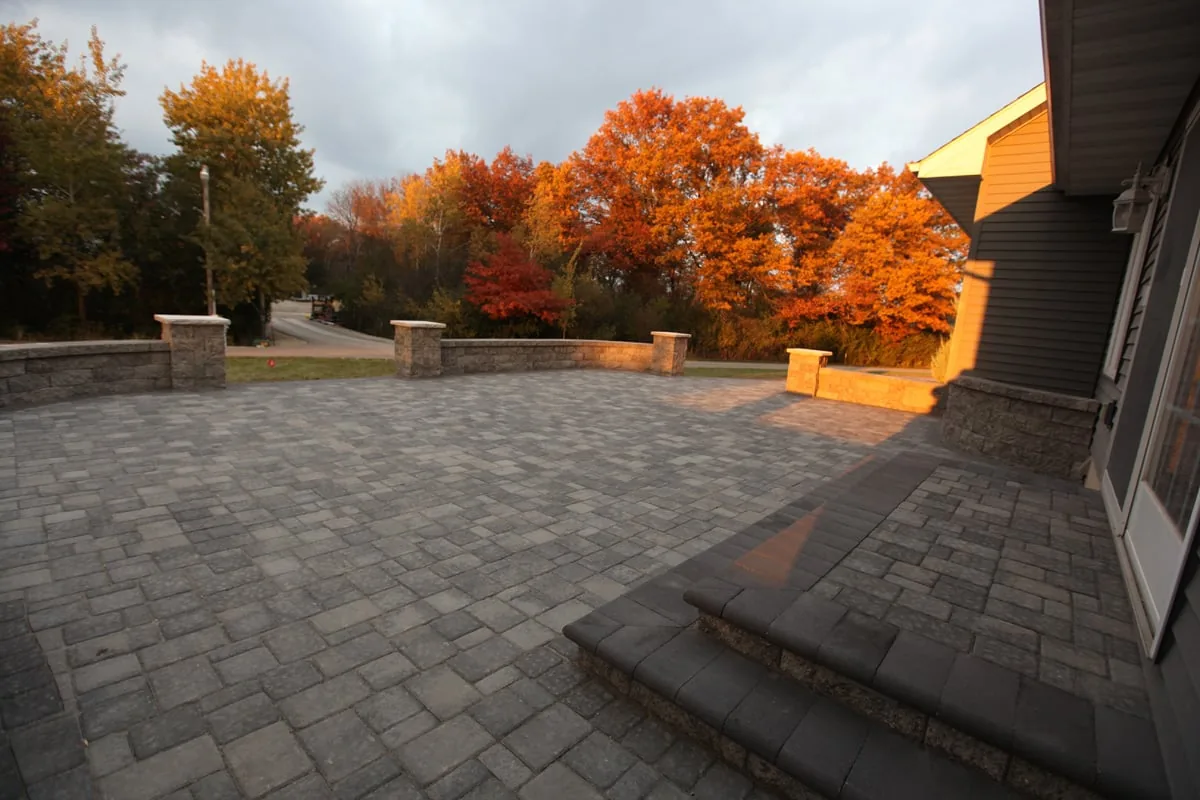
Steps take more abuse than any other part of a yard here. Frost heaves the ground under them every winter, snow and ice sit on them for months, and they get walked on every day. At Peters’ Patio and Landscape, we build outdoor steps for homeowners in Rochester and across southern Minnesota: front entry steps up from the driveway, wide steps off a patio door, and short runs of steps that connect a paver patio to the lawn on a sloped lot.
Most of the steps we replace in Rochester are old poured concrete that has cracked and settled, or wood steps that have rotted where they meet the ground. Concrete steps are one solid piece, so when frost lifts one corner the whole step tips and cracks. Paver and block steps are built from separate units on a compacted base, so they flex with the ground through freeze and thaw, and a damaged unit can be lifted out and replaced instead of tearing out the whole step.
We build steps three main ways. Paver steps use wall block or step units with matching caps, in colors that tie in with your patio or front walk. Natural stone steps use large slabs, often limestone, for a heavier, more natural look on hillsides and garden paths. Boulder steps are set into a slope alongside boulder walls, which works well for a path down to the backyard. One homeowner wrote that we built “several boulder walls, boulder steps to the backyard, paver patios, and all of the finishing landscaping.”
Good steps start below ground. We dig out the area, install and compact an aggregate base in layers, and set each step on solid footing so it stays level. Every step gets the same rise and a tread deep enough to walk comfortably, because an uneven step is the one people trip on. We pitch each tread slightly so rain and melting snow run off instead of freezing in place. For a closer look at the base work, read how we install pavers.
What to Expect From a Steps Project
We start by looking at the slope, the door or patio the steps will serve, and where water runs when it rains. From there we settle the number of steps, the width and the materials. Wider steps are easier to carry furniture and groceries up and look better off a patio door. We also talk through built-in step lights, which make each step edge easy to see after dark and cost far less to add during the build than after it.
Plan for winter care too. Rock salt is hard on steps: the University of Minnesota Extension notes that heavy use of deicing salt damages stone and concrete, and it burns the plants beside the steps. Shoveling early, using sand for grip, and going light on salt will keep your steps looking new much longer.
Steps often go in alongside a new patio or front walk, but they can also be a project on their own, and a small job gets the same full crew. One homeowner shared, “They built a stone staircase off the back of our house to our preexisting patio. It was a small project, but they sent a whole team of people and had it done in one day.”
Get in touch today to schedule a consultation for your next project!
Need More Inspiration?
Are you looking to renovate your property but are not sure what to add? View our gallery to see the many attractive landscapes and outdoor living areas we have previously designed and built.